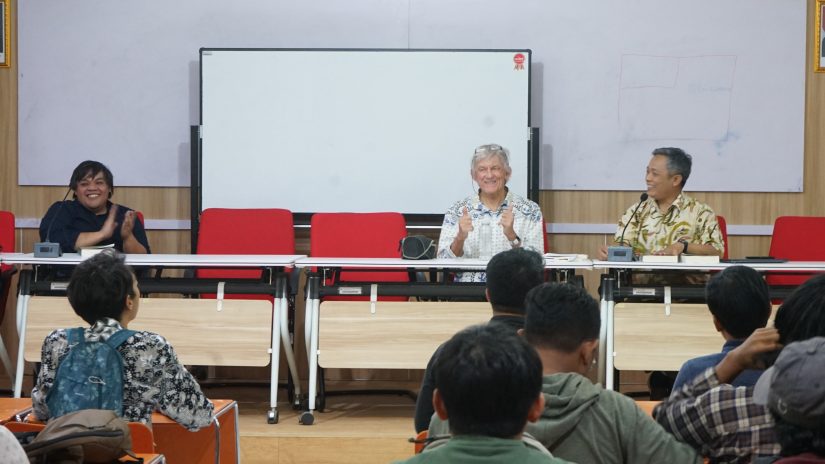
On Friday, November 21, 2025, at the Margono Multimedia Room, Faculty of Cultural Sciences, Universitas Gadjah Mada (UGM), the Department of History in collaboration with Yayasan Obor Indonesia held a book launch and discussion event for Bacaan Bumi: Pemikiran Ekologis untuk Indonesia (Reading the Earth: Ecological Thought for Indonesia). This book is a work of Indonesian environmental historiography, produced through the collaboration of Indonesian and international writers, historians, and scholars with a shared interest in environmental studies, under the editorial responsibility of Prof. Gerry van Klinken, emeritus professor at the University of Amsterdam, the Netherlands.
The event was attended by Dr. Abdul Wahid, M.Hum., M.Phil., and Dr. Farabi Fakih, S.S., M.Phil., representing the Department of History at UGM and also contributing authors to the volume. Broadly speaking, the book seeks to renew Indonesian historiographical narratives by foregrounding non-human actors who play significant roles in shaping social, political, and economic developments both in Indonesia and globally. At the same time, the work conveys a moral message and offers a sharp critique of capitalism—both in Indonesia and worldwide—that has increasingly taken on extractive and exploitative forms, often disregarding the environmental damage it causes.
In his presentation, Prof. Gerry van Klinken elaborated on the role and position of animals as non-human actors in the course of human civilization. Animals, he argued, should not be understood merely as “extras” in historical dynamics, but as entities with distinct characteristics and positions that actively shape human history. He emphasized that the behavioral patterns and everyday practices of animals reflect a form of reasoning and collective intelligence developed within their communities. He introduced Critical Animal Studies as an approach to understanding the intellectual and mental realities that emerge through the interactions, dynamics, and conflicts among animals, humans, and nature.
The discussion was further enriched by responses and contributions from Dr. Abdul Wahid and Dr. Farabi Fakih, who expanded upon Prof. van Klinken’s ideas and connected them to broader historiographical debates.
Throughout the book launch and discussion, participants engaged actively with the speakers, asking questions and contributing to the dialogue. This created a lively, communicative atmosphere and ensured that the event unfolded as a genuine two-way exchange.
A recording of the discussion is available at the following link:
Penulis: Mochamad Rizky Saputra