
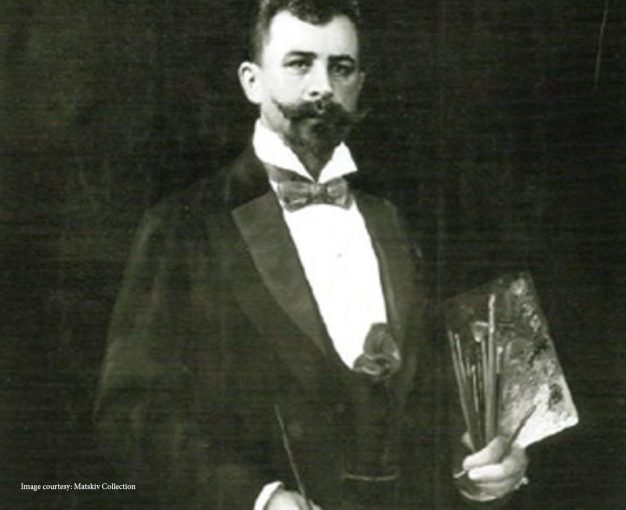
Portrait of Hugo Vilfred Von Pedersen. Source: Matskiv Collection
“Jogja is made of longing, homecoming, and street-food stalls, Jogja terbuat dari rindu, pulang, dan angkringan,” a line crafted by Joko Pinurbo, one of the city’s treasured literary voices, capturing the gentle pull this capital of Javanese culture holds for many. Each element reflects the city’s simple and familiar faces, always present, though often overlooked by those drawn exclusively to the grandeur of Javanese courts or temples.
Hugo von Pedersen was an exception. The Danish artist, fond of sketching scenes of daily life, visited the city in the late nineteenth century and sensed something remarkably akin to what Joko Pinurbo would later evoke. His paintings are now displayed in some of the world’s most esteemed galleries, while some of his sketches reside in the National Museum of Denmark.
Pedersen was a painter with a keen eye for quotidian richness of any place, he left a vivid record of the archipelago during that era. His paintings and sketches of Indonesia hold remarkable depth, yet his name often slips from public memory in the wider story of people-to-people friendship between Indonesia and Denmark.
The year 2026 marks the 130th anniversary of his visit to Indonesia, and before that moment arrives, we have a fine chance to revisit his story, his works, and the legacy he left through his visual archives and his travelogue Door Den Oost-Indischen Archipel: Eene Kunstreis (To the East Indies Archipelago: An Art Journey), translated into Dutch by S. Kalff.
A Curious Københavner
Pedersen grew up in Copenhagen, where he spent most of his formative years in fine arts ateliers before continuing his training in major German cities. His journey to Asia, however, followed a different current. Drawn by the global tobacco boom in North Sumatra, he travelled east in 1896, following his brother who worked in a tobacco plantation, which appears to have been Deli.
At twenty-six, the painter carried a lively curiosity during the voyage, though he still moved within the broad European gaze toward the “Orient.” While passing through India, he sketched everyday figures who crossed his view, labelling them collectively as Hindus. His curiosity and diligent hands continued when he reached Sumatra, which included stopovers in the busy port cities of Penang and Singapore.
He was more than simply curious, for he always managed to capture the true value of the region. His drawings from North Sumatra, for instance, reveal a vibrant mix of communities. He sketched Malays, such as a man climbing for coconuts, Chinese residents and their temples, and Batak figures. He even depicted two Afghans, identifiable by their turbans, who oversaw what he described as a “traditional fire alarm,” referring to the kentongan.
Painting Abdi Dalem

In the late 1890s, Pedersen continued his journey to Java, a land that understandably left him in awe. He managed to visit the royal territories of Yogyakarta and Surakarta, with side trips to Madiun and Malang. Like other proponents of the Mooi Indie perspective, Pedersen’s memoirs cannot conceal his admiration for the grandeur of Javanese courts and temples, especially Borobudur.
Pedersen even gained access to the courts in both Yogyakarta and Surakarta. It appears that few in the Javanese courts realized that some of their royal portraits were created by an artist who had travelled all the way from Copenhagen. According to Jade De Beaulieux in Hugo von Pedersen: A Danish Artist in Indonesia, Pedersen drew six Javanese royals not counting their Dutch counterparts during his visit. Over the course of his career, the Dane produced portraits of twenty-six high-ranking figures from around the world, ranging from Queen Wilhelmina of the Netherlands to the Maharaja of Mysore.
Despite his privileged access, Pedersen never lost sight of the everyday pulse of the Javanese courts. In Yogyakarta, his depiction of the 1898 Gerebeg, a royal festival in which the sultan offers blessed agricultural produce shaped into a miniature mountain, focuses not on ceremonial grandeur but on three abdi dalem, court servants, serving as the royal horsekeepers. Two steady the reins while another guides the horse, adorned in royal equestrian regalia, beneath a parasol.
This approach remains consistent in other works. At court ceremonies, he often sketched processions from behind, allowing the solemnly seated abdi dalem to dominate the composition, their backs turned to the viewer. Royal figures and Dutch residents appear further away and smaller, subject to the laws of proportion in his drawing. At Surakarta’s sunan service, Pedersen maintained this perspective. Even when granted access to the sunan himself, he continued to foreground the men in service, figures often overlooked by court painters who focused exclusively on rulers and their immediate families.
Taken together, Pedersen’s works provide valuable insight into the functioning of Javanese courts from the late nineteenth to early twentieth century, highlighting not only the throne but also those who sustained the kingdom’s everyday sovereignty.
Shared Stories

Few Danish museums hold collections related to Indonesia, partly because the two regions lie far apart. Among the rare pieces, Pedersen’s sketches stand out and form the core of the visual materials labeled “Indonesia” at the National Museum in Copenhagen. His paintings, now dispersed across the world and including one sold at Christie’s for 65,000 US dollars, present subjects he regarded as suited for full canvases. His sketches, in contrast, capture his first impressions and the fleeting moments that drew his attention.
According to the Danish National Museum’s digital database (samlinger.natmus.dk), at least twenty-four sketches on Indonesia during the colonial period is listed under Pedersen’s name. Each one reflects his enriching travels, including his memorable journey across the archipelago. These works reflect the shared history between Denmark and Indonesia and provide rich material that could inspire research and study in both countries.
Ultimately, Pedersen, his works, and his story merit a larger place in the shared narrative of friendship between Denmark and Indonesia, a relationship that has grown formally since 1950, even as the two archipelagos have engaged with one another since the early 17th century through the presence of the Danish East India Company in Java and Sulawesi. Honouring his work reminds us that connections between nations can grow through the simple rhythms of everyday life, showing that people-to-people ties often endure longer and reach deeper than formal political relations.
Readers interested in exploring Indonesian-related collections in Danish museums can visit the user-friendly website https://samlinger.natmus.dk/objectbrowse?keyword=Indonesia . It is worth noting, however, that the site is available only in Danish.
Author: Satrio Dwicahyo