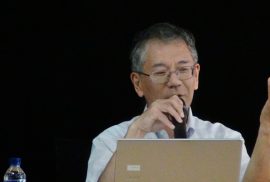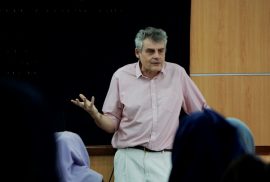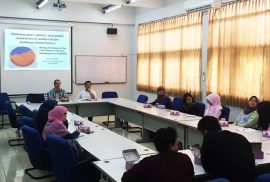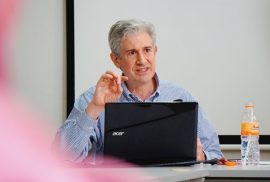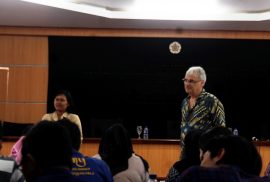
One of the milestones of national revival came from STOVIA. The Javanese medical school became important in the Indonesian nationalist movement. The reason was based on the emergence of Boedi Utomo on May 20, 1908, whose initiators were mostly STOVIA students. This was stated by Prof. Hans Pols from the University of Sidney in a public lecture themed “The Indonesians Medical Profession in the Dutch East Indies: Medicine, Nationalism and Decolonization” by the Department of History UGM on Monday (10/4) at FIB UGM. According to Hans, the medical student at STOVIA at the same time not only learned about health but also about nationalism and the importance of independence. “At that point, then the medical profession had a vital role at that time,” Hans said.
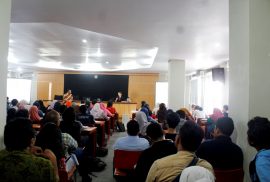
On Monday (3/4) Marjolein van Pagee, the founder of Histori Bersama, had the opportunity to attend a discussion held by the UGM History Department, in the Multimedia room, second floor, Margono building, FIB UGM. Marjolein tells about the Joint History and the historical relationship between the Netherlands and Indonesia. “Indonesia and the Netherlands, admit it or not, they are connected to each other because of colonization, and it’s not a short time,” said Marjolein.
According to Marjolein, a shared understanding of the history of the two countries is very much needed. It is useful for healing the wounds of the two countries’ past. Furthermore, the woman who studied colonial history at Leiden University explained the reason for the presence of the Joint History. The foundation exists as a bridge connecting the two countries. In the end, Marjoleine hopes that what she does can help to avoid the misunderstanding of the history of the two countries that is still ongoing. For him, true reconciliation comes after understanding.
Demographic issues have emerged as a common topic nowadays. According to LIPI’s report, in the years 2020 until 2030, Indonesia will get a demographic bonus. At that time, the population in Indonesia will increase. The number of productive age population (17-64 years) will be more than the non-productive age. The comparison touches the number of 70 to 30 percent. This is in contrast to the situation in Japan. The population curve in the land of the ‘rising sun’ forms an inverted triangle. Japan suffers from the burden of a large aging population.
Saturday morning (18/3) the atmosphere in the courtyard of the Poerbatjaraka building, Faculty of Cultural Sciences, UGM was suddenly crowded. Several people were seen shaking hands and laughing. Not a few also hug. That day the History Department held a Grand Reunion. The event was held for two days, March 18-19 at the Faculty of Cultural Sciences UGM. Participants consisted of history alumni from various generations and strata. The organizing committee -which consists of several initiators from the alumni circle- carries the theme “The Past Is Always Actual”.
The New Order became an important material in the study of contemporary Indonesian history. Not only because of the length of time in power – namely 32 years, but the New Order gave a historical legacy, which is still being felt today. However, what became interesting for researchers was how the New Order state scheme worked. UGM historian, Farabi Fakih, in his dissertation said that the New Order was a Managerial State. A terminology that shows that the New Order worked like a corporation.
Benevolent Bandits?
At that time Prof. David Henley started the presentation with a question. Was the New Order good bandits? In his research, he uses a political perspective by borrowing the concept of a stationary bandit. In simple terms, stationary bandits are political elites (central) who use their power for the wrong purpose – namely strengthening networks and then fulfilling personal interests – by forming groups in other areas of the country. The concept was introduced by Mancur Olson in his book Power and Prosperity. Mancur Olson selected Russia in the early 1990s and China in the early 20th century as sample areas.
Peter Boomgaard became important in the development of Indonesian historiography. For some historians his expertise in pioneering environmental history is a challenge. He provides an alternative to mainstream historiography – which used to be militaristic and political. Why is this environmental historiography unique? Boomgaard’s idea no longer places human relations between humans – which is a feature of political, military, or even social historiography in subsequent social developments. History is not about war and power. Peter Boomgaard does not eliminate the role of humans, because humans are an important element of history. However, – through the idea of environmental history – he has the idea that history is also the relationship between humans and nature. So history has wider interdisciplinary possibilities, even including the realm of science which is no longer fixated on the social science approach. So history can discuss the relationship between humans and nature: interactions with fauna, natural disasters, and the history of disease outbreaks.
The History Department of FIB UGM held public lectures in succession. on Friday (10/2) and Monday, (13/2). The public lecture invited Dr. Russell Field of the University of Manitoba. He is an assistant professor who specializes in sports, particularly sports and politics. At the first meeting, Friday (10/2), Dr. Russell focuses more on sports and historiography.
From the research results of Dr. Russell on Ganefo there are some interesting findings. Ganefo which was held in 1963 was not held without consideration. it is a symbolic embodiment of Soekarno’s vision. Views on Asian-African unity, decolonization spirit and Anti-imperialism. In its development, Ganefo became a rival to the Olympics. Because according to Soekarno and several figures from the eastern block countries at that time, sport could be a means of infiltrating western to eastern culture. That’s what they then fought.
Dr. Russell Field, on Friday (10/2/2017) had the opportunity to attend a public lecture in Meeting Room I, Poerbatjaraka Building, Faculty of Cultural Sciences UGM. A research assistant from the University of Manitoba Canada, he gave a public lecture with the theme “Studying Sport, Politics, and Global Connection”. The event was organized by the Department of History, Faculty of Cultural Sciences UGM. The public lecture was the first schedule of two planned public lectures with a discussion of sports and history.
Department of History FIB UGM, on Monday (16/01/2017) held a public lecture with the theme “Land, Lumber, Labor, and Excrement: The Circular Economy of Nineteenth Century Tokyo Tokyo Slums’. The public lecture invited speakers from Georgetown University, namely Prof. Jordan Sand, located in Purbatjaraka Building, 1st floor, FIB UGM.
In his presentation at the UGM FCS at that time he explained about urban slum areas in Tokyo. Of course this is a serious problem from the perspective of the Japanese government. Then the problem is, the formalization of real estate to be built, has to swallow up slum areas filled with small houses and huts. Prof. Jordan saw it as a fight. In the case of Tokyo, if it is relevant to the current context, it helps to reconsider the unplanned settlements, of which there are not many. And on the other hand also to overcome it.