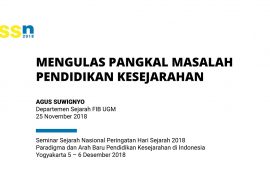
After 1998, the writing of history in Indonesia developed rapidly with new sources and methods. This is not directly proportional to the teaching of history in the classroom which remains monotonous. The absence of historiography and history writing problems as well as the ability of teachers to teach have contributed to the undeveloped teaching of history in schools. Historical writing always contains methodological limitations and is interesting to discuss. If this is presented in teaching in schools, both teachers and students will be able to discuss and criticize history and historical writing. In reality, teaching history in schools only presents the substance of historical events as written in the text. This method makes activities in the classroom very passive, because students only repeat readings from books without discussing historiographical problems and methodological problems. One way that can be done to create a critical attitude among students about methodology and historiography is by presenting various writings that discuss the same theme. This shows that historical writings can be written from various perspectives. In improving the competence of teachers, we cannot be separated from the educational background they received before becoming educators. Each teacher was educated at a different time. To improve the quality of teachers, improvements must be made to the teacher education process. “Scientists who are Masters” or “Ilmuwan yang Guru” are needed to accomplish this. One must be qualified as a scientist in his field before being prepared to become a teacher. They must not only master the substance of the field of science, but also the methodological process and axiological problems of the science. If this is already owned, then he will be ready to become a teacher. In the field of history, for example, prospective teachers must have an understanding of historical philosophy and historical methodology.
Hans Visser’s book, Wieteke van Dort: Kind van Twee Culturen; Een familiekroniek was published on October 25, 2018. However, as a journalist working with Noor d-Holland Dagblad, it seems that Hans is quite interested in telling the story to the public.
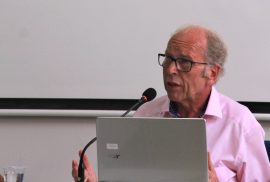
On Thursday, November 2 2018, the UGM History Department invited Hans to tell the story of Wieteke van Dort’s life. The event was held from 1 to 15.00 in Meeting Room 1, Poerbatjaraka Building, FIB, UGM.
According to Hans, what is interesting about Wieteke is the origins of the two cultures that have influenced him, Java and the Netherlands. Yes, all because Wieteke is indeed an Indo. Born in Surabaya on May 16, 1943, Wieteke is the daughter of a Dutch father and Javanese mother. Unfortunately, when he was visiting the Netherlands at the age of 18, his family decided to settle in Den Haag
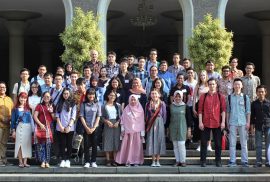
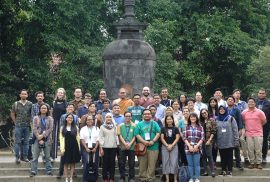
As citizens of modern Southeast Asia, we often take for granted nation-state that in fact is a new concept. Not only it is contemporary, border that demarcate states both on water and land is innately artificial and porous. Department of History, Faculty of Cultural Sciences UGM initiated “International Summer School on Southeast Asian Studies; Transnational History: Becoming a Cosmopolitan Historian” to promote perspective that transcends border for young and potential researchers. The summer school took place at Faculty of Cultural Sciences Universitas Gadjah Mada from 27th August– 6th September 2018. Participants of this summer school are undergraduate and graduate students as well as young lecturers from Australia, Japan, Malaysia, Thailand, United States, and Vietnam. This summer school also incorporates Indonesian students from state universities throughout the country.
Organized by History Department, Faculty of Cultural Sciences and Faculty of Social and Political Sciences, Universitas Gadjah Mada
Transnational history has produced a significant body of work since its development in the late 1980s and early 1990s. This approach owed its inception as part from the shift from political history that was comfortably located within the national narrative toward social and cultural history in the 1970s and 1980s that developed perspectives such as race, ethnicity, class, and gender that was localized and non-national. These developments, unfortunately, had worried historians because of the parochial and antiquarian nature of local histories. The early 1990s and 2000s saw the publication of David Thelen’s Toward the Internationalization of American History and Thomas Bender’s Rethinking American History in Global Age from which efforts to provincialize and denationalize American history has pointed the way for a true dialogue of experts from all parts of the world in imagining differential spaces other than that of the nation-state. This is needed in order to construct an American historiography that could meet the current needs of a globalizing world and place it with emphasis on a perspective of the future. Instead of focusing on local phenomenon, the emphasis was on understanding social, cultural and political ones as a transnational process; reconceptualizing identities, communities, and products within different transnational framework; for instance, Hollywood movies as it was received and recreated on other parts of the globe and thus seeing it not merely as an American cultural product, but a wider globalizing phenomenon. Bruce Mazlish and Ralph Buultjen’s edited volume Conceptualizing Global History expands this further by bringing forth ideas in developing global narratives of local or non-national identities and spaces. Two approaches that were identified by Thelen has been to focus on either borderlands, as liminal spaces in which national units undergo transformative shifts, and the comparative approach, not merely as a means for national historians to compare each other’s narratives but to create new perspective altogether that is both national and international.
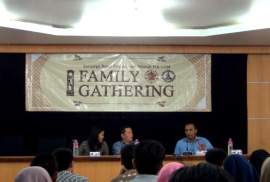
On Saturday 9th September 2017, Department of History UGM held a “family gathering” in Multimedia Room, Margono Building, Faculty of cultural science UGM. This event was a form of collaboration between department and Keluarga Alumni Sejarah Gadjah Mada (KASAGAMA) which then also involved students as the executor. This event was one of the series of welcoming new students of History 2017. The theme of this event is “History and Prospects of the World of Work”.
There were three resource persons in this event who shared their experiences about the prospects for the world of work in the field of historical studies. They are Zakaria Effendi, Rina Widyastuti, and Sambodo. Rina Widyastuti, who now has a career at Tempo, explained that her knowledge supports her profession, which is currently pursuing journalism. In History, she is required to always be diligent in writing and that is what makes her accustomed to working under pressure.
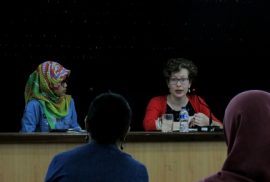
Colonial education was always synonymous with ethical politics. A policy of repaying the colony’s land, rather than previously exploiting it. This resulted in historiography discussing colonial education always focused on the government. That education cannot be born without government intervention – the Dutch East Indies. This was stated by Kirsten Kamphius in a seminar entitled ‘Our Girls’: Taman Siswa as an example Gendered education in the Netherland Indies 1922-1942, on Wednesday (19/7) in the Multimedia Room of the Margono Building, FIB UGM.
Talk with the alumni of the history department, Universitas Gadjah Mada, which was named “Alumni Menyapa” was held in the Multimedia room, 2nd floor of Margono Building FIB UGM, on Monday, 15th May. The talk with history alumni was the inaugural edition and took the theme ‘History and the World of Work’. The activity, which was packaged in the format of a talk show and interactive dialogue, was a work program of the Gadjah Mada History Alumni Family (KASAGAMA) in collaboration with the Department of History, Faculty of Cultural Science UGM.
Leiden-based senior researcher at the Royal Netherlands Institute of Southeast Asian Caribbean Studies (KITLV), Marieke Bloembergen, on Thursday (20/4) gave a public lecture on India’s scientific networks, religion and spiritual movements. The public lecture was held by the Department of History, FIB UGM, in Meeting Room I, Purbatjaraka Building, FIB UGM. This public lecture has the theme “Beyond A Dutch Empire, Beyond Indonesia? : Scholarly and Religious Networks, Spiritual Movement and Moral Geographies Of Greater India Across Decolonization, 1920’s-1980’s” and was attended by FIB students from various strata.
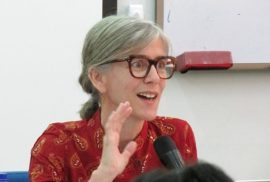
The exploitation of woman as sexual slaves during the Japanese occupation was a series of planned and organized system. During the Greater East Asia war, Japan realized the basic need for soldiers. It was possible at that time to use indigenous women as ‘comfort women’. This was stated by Katherine McGregor in a public lecture held by the Department of History FIB UGM, on Tuesday (25/4), in the Multimedia Room, Margono building lt. 2, FIB UGM.
On that occasion Katherine gave a public lecture with the topic “Piecing Together the Threads of the So-called ‘Comfort Women’ System During the Japanese Occupation of Indonesia”. Katherine, a woman who also a professor at Melbourne University, explained in detail about sexual slavery system during Japanese occupation. “So, what happened to the sexual slavery during Japanese Occupation was something that was planned”, said Katherine.
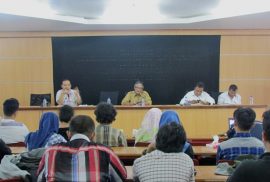
“Now answer me, is there any category beside literature sociology?” ask Bambang Purwanto to the students of the doctoral program in the Department of History UGM. They explained their plan for the dissertation proposal in front of him. Bambang views their research proposal still has some weakness and is less contextual. This was delivered at the public lecture about dissertation writing themed “From Research Question Proposal to Thesis Writing” on Wednesday (19/04) in Meeting Room I, Poerbatjaraka Building, FIB UGM.