
CALL FOR PAPER WORKSHOP
Forms of Vulnerability and Means of Resilience in Colonial Environments: Moments and Limits of Colonial Extractivist Acceleration in the Dutch East Indies (1800-1945)
Location: Universitas Gadjah Mada
Wednesday 25 November
Organisers: Dr. Abdul Wahid (UGM), Dr. Roel Frakking (UU), Wietse de Jonge (UU)
The Departments of History at Universitas Gadjah Mada and Utrecht University invite submissions for a workshop exploring vulnerability, resilience and colonial extractivism in the environmental history of the Dutch East Indies (1800-1945). The workshop offers a collaborative space to exchange ideas, share ongoing work, and discuss the methodological and empirical challenges in the field.
Dutch colonial rule in Indonesia was not only a political and economic project, but also caused profound environmental transformations. Across the archipelago, plantations, mines, and infrastructural projects reshaped human and nonhuman worlds alike, often with lasting consequences. Peter Boomgaard and colleagues argued in Paper Landscapes: Explorations in the Environmental History of Indonesia (1997) how “Outside forces, such as foreign trade, foreign overlords, migrants, new crops and new diseases have always had a profound influence on the ways in which Indonesia’s natural environment was exploited”. Simultaneously, scholars such as Nancy Peluso have complicated this picture from within, demonstrating how indigenous communities maintained access to critical resources and resisted harmful colonial forestry policies (Peluso. 1994). More recently, plantationocene scholarship has made efforts to more fundamentally explain the deeply entangled relationship of the global climate crisis and the history of European imperialism (Haraway, 2015). Authors such as Malcolm Ferdinand and Anna Tsing have demonstrated how plantation systems, and colonial extractivism at large, transformed landscapes and societies in ways that continue to shape contemporary ecological crises and social inequality.
The enduring weight of these colonial plantation logics is perhaps nowhere more visible than in contemporary Indonesia, where life on contemporary palm oil plantations replicates colonial-style relations of production and control which undermine citizenship, foreclose indigenous land rights and build on ruined ecologies (Semedi & Li, 2021). Yet, scholars have cautioned that the Plantationocene perspective risks universalizing histories of exploitation in ways that re-center European narratives at the heart of global environmental change (Curley & Smith; 2024). Hence, environmental historians have urged a history from below, foregrounding the resilience and alternative geographies of local and indigenous communities faced with environmental challenges (Hazareesingh, 2013). Building on this historiography, this workshop asks how colonial rule produced differentiated forms of vulnerability to environmental change, and how resilient indigenous institutions, social networks, and livelihood strategies enabled communities to mitigate the effects of colonial occupation of land and resources.
Rather than treating the colonial period as a uniform expanse, it takes as its empirical entry points specific moments of extractivist acceleration; specific junctures and epochs at which the Dutch colonial project induced or threatened rapid environmental transformation. Hence, from an empirical perspective, this workshop aims to identify and shed light upon crucial moments in the making of Indonesian colonial environments; the Cultivation System (1830–1870), Deli plantation belt (1863–1942) and the opening of commercial oil production in the late 1800s are all examples of such moments. The workshop has a twofold aim. First, it asks how these environmental transformations produced differentiated forms of vulnerability. Possible avenues include how the expansion of plantations and cultivation obligations affected livelihoods and access to resources, or how the colonial government shaped the unequal distribution of harm during environmental crises – through taxation, restrictions on mobility or insufficient relief policies – such as the famines that affected Java during the 19th century. Who, in short, was made vulnerable, and at what cost during these moments of accelerated extraction?
Second, the workshop examines how (in)formal indigenous institutions and social networks employed resilient strategies in response to the changes of colonial environments. This might include how village councils and other local institutions negotiated or resisted colonial demands to allocate land for compulsory crops, or how existing systems of communal resource management and reciprocal labour provided means of distributing risk and sustaining livelihoods during periods of exploitation. Resilience could also take the form of adaptation: changes in agricultural calendars and crop choices, the diversification of livelihoods, or the incorporation of new crops and market opportunities. The workshop invites contributions that explore how such means of resilience operated in particular ecological and colonial contexts, and whether they strengthened communities’ capacity to cope with environmental change or, in time, produced new forms of vulnerability.
The colonial archive that underlies much of this history is not a neat and orderly record of how Europeans conceptualised colonised landscapes, but a fissured epistemological terrain; as officials relied on different groups of indigenous actors for knowledge about land tenure, crops and soils, as well as agricultural practices, colonial sources equally contain the experiences and practices through which communities negotiated changing environments. Vernacular sources, oral traditions, and community memory are not opposites to this archive but its necessary complements, together enabling fuller and more contested histories of Indonesian (post)colonial environments.
The workshop welcomes contributions that engage with one or more of the following themes:
- Plantation logics and extractive environments (including extractivist resources such as tin and oil)
- Indigenous knowledge, institutions, and resilience under colonial rule
- Multispecies histories
- Food security, health and agrarian crises
- Climate and disaster studies
- Comparative and connected histories of environmental resilience
The workshop does not seek to adjudicate between theoretical frameworks, nor to impose a single methodological approach. It proceeds from the conviction that the colonial environmental history of Indonesia is best served by a plurality of perspectives; empirical and theoretical, archival and field-based, human-centered and more-than-human. Contributions from historians, historical geographers, anthropologists, and scholars working at the intersection of history, postcolonial studies, STS, and environmental humanities are all welcome. We particularly encourage submissions from early-career scholars, and researchers working with vernacular and non-Dutch sources.
Format: Participants will present their work in 20 minute presentations, followed by discussions. (Preference will be given to in-person presentations, yet a number of online participants welcomed)
Submissions Guidelines: Please submit an abstract of 250–300 words along with a biographical note (max. 100 words)
Deadline for submissions: 19 October (please send submissions to Wietse de Jonge, w.w.dejonge@uu.nl
Contact Mail: kang_ahid@ugm.ac.id or w.w.dejonge@uu.nl
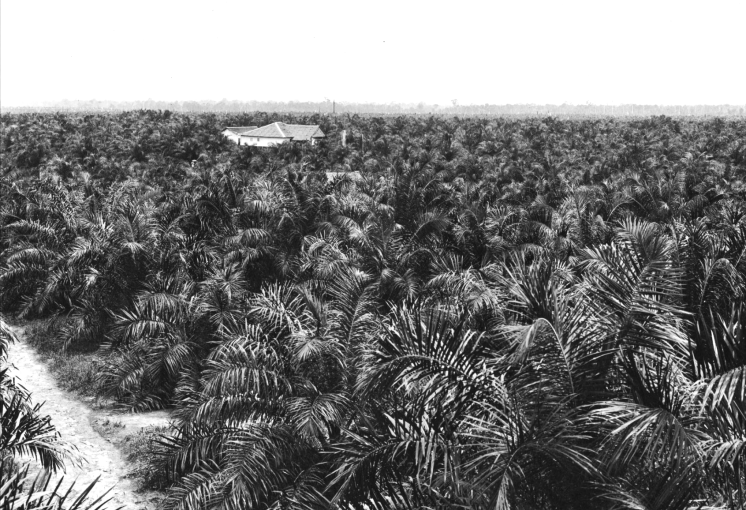
Image: Oliepalmplantage, vermoedelijk op onderneming Totolan in de Oostkust van Sumatra.
Source: KITLV (A891) http://hdl.handle.net/1887.1/item:926446